How Does Initial Moisture Affect Veneer Drying?
Why do some veneer sheets dry quickly while others remain damp or become brittle? The answer often starts before the drying process even begins. Initial moisture content affects drying speed, energy consumption, and the final veneer quality. At Shandong Shine Machinery, we believe better moisture control creates better products and more efficient production.
A wood veneer dryer must handle changing moisture levels without sacrificing sheet quality. Therefore, understanding initial moisture helps manufacturers choose suitable drying conditions. It also helps operators improve productivity, reduce waste, and control operating costs. After all, nobody wants perfectly peeled veneer ruined by poor drying decisions.
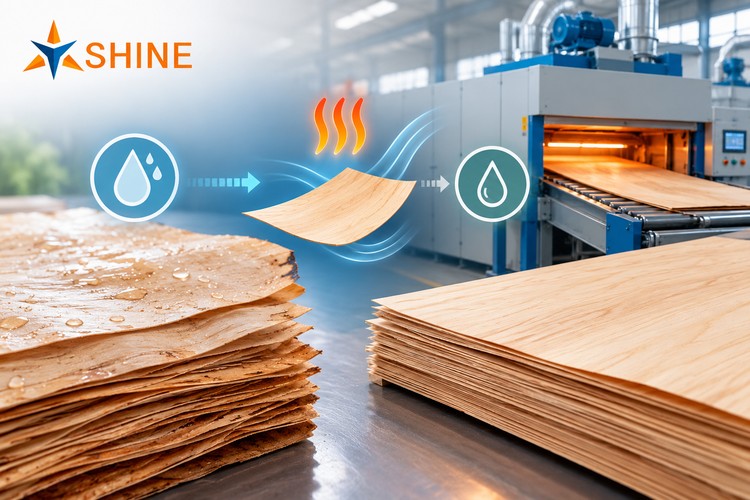
What Is Initial Veneer Moisture?
Initial moisture content describes the water present in veneer before drying. Manufacturers usually express veneer moisture content as a percentage of oven-dry wood weight. Freshly peeled veneers often contain substantial water, although species, thickness, and log conditions affect the actual level.
Why Does Moisture Content Vary?
Several factors influence the moisture level of wet veneer:
Wood species: Different species hold different amounts of water.
Log condition: Freshness, storage, and temperature influence moisture distribution.
Veneer thickness: Thicker sheets generally require more time for moisture removal.
Peeling conditions: Cutting methods and surface characteristics affect water movement.
Storage time: Delays after peeling can change moisture levels.
Consequently, two batches from the same production line may behave differently inside a veneer dryer. We recommend measuring incoming moisture rather than relying on appearance alone.
How Initial Moisture Affects Veneer Drying
Initial moisture directly influences how much water the drying process must remove. Higher moisture usually means longer drying cycles and greater heat demand. However, the relationship also depends on veneer thickness, wood species, airflow, and temperature.
Higher Initial Moisture Requires More Energy
When veneer enters the dryer with more water, the machine must supply additional energy to evaporate it. This increases energy consumption and may extend the production cycle. If operators increase temperature too aggressively, the veneer surface may dry faster than its inner layers.
That imbalance can cause uneven moisture, curling, checking, or other defects. Instead, operators should adjust temperature, airflow, and conveyor speed according to the actual material conditions. Consistent monitoring helps prevent unnecessary heating and protects the final product.
Lower Initial Moisture Can Shorten Drying Time
Veneer with lower initial moisture generally needs less water removal. As a result, operators may reduce drying time or increase production throughput. Nevertheless, starting too dry can create other problems if the material loses moisture unevenly or becomes excessively brittle.
We encourage manufacturers to target a suitable incoming moisture range instead of chasing the lowest possible reading. The goal is efficient drying, not winning a contest to produce the driest incoming sheet.
Finding the Right Drying Conditions
A reliable veneer dryer balances heat, airflow, moisture removal, and material movement. No single temperature or conveyor speed suits every species and thickness. Operators should establish settings through measurements, production trials, and product requirements.
Key Parameters to Monitor
For more consistent veneer production, track these practical factors:
Initial moisture: Measure representative samples from each batch.
Veneer thickness: Record thickness in millimeters (mm).
Drying temperature: Monitor air temperature in degrees Celsius (°C).
Drying speed: Adjust conveyor speed to match moisture and thickness.
Final moisture: Verify the target using a calibrated moisture meter.
Airflow: Maintain even drying air distribution across the sheets.
These measurements help operators identify problems before defects spread across an entire batch. They also provide useful data for optimizing modern dryers and improving repeatability.
Protecting Veneer Quality During Drying
High-quality drying requires more than removing water quickly. Excessive heat or uneven airflow can damage the veneer surface and weaken thin sheets. Meanwhile, insufficient drying may leave moisture that interferes with later processing.
Avoid Uneven Drying and Surface Defects
Good control helps manufacturers produce quality veneer with fewer cracks, wrinkles, and moisture variations. Operators should inspect sheets after drying and compare results with incoming measurements. When defects appear, they should review temperature profiles, airflow balance, and conveyor settings.
Stable moisture also supports downstream operations. For example, consistent veneer moisture can improve handling and help manufacturers prepare sheets for hot pressing. However, the ideal moisture target depends on the adhesive system, panel specifications, and production requirements.
Reducing Energy Consumption Without Sacrificing Quality
Manufacturers can reduce drying costs through better process control rather than simply applying more heat. First, measure initial moisture and group similar batches together. Next, optimize conveyor speed and temperature to avoid unnecessary drying.
Use Heat Recovery and Smart Monitoring
Heat recovery systems capture usable energy from exhaust air and return it to the process. This approach can reduce fresh heat demand when the equipment design and operating conditions support effective recovery. Regular maintenance also helps preserve airflow and heating performance.
We recommend recording energy use per unit of dried veneer, such as kWh per cubic meter (kWh/m³), when suitable production measurements are available. Compare results across similar species, thicknesses, and incoming moisture levels. This makes efficiency improvements easier to verify.
How Manufacturers Can Improve Results
At Shandong Shine Machinery, we see moisture management as an essential part of reliable veneer production. A well-selected wood veneer dryer works best when operators understand the material entering the machine. Good equipment and sound operating practices must work together.
Use this checklist to strengthen your drying process:
Measure initial moisture before loading.
Separate batches with significantly different moisture levels.
Confirm veneer thickness and target final moisture.
Adjust drying conditions gradually.
Inspect dried sheets for cracks, curling, and uneven moisture.
Review energy consumption and production records regularly.
These steps help manufacturers reduce drying time where practical while protecting product consistency. They also support better planning, lower avoidable waste, and more predictable operating costs.
Conclusion
Initial moisture affects nearly every important aspect of veneer drying, from cycle time to energy consumption and final product quality. By measuring incoming moisture and adjusting drying conditions, manufacturers can improve efficiency without exposing sheets to unnecessary heat. At Shandong Shine Machinery, we believe consistent results begin with understanding the wood, controlling the process, and choosing equipment that matches production needs.