What Moisture Content Should Veneer Have?
What Is the Ideal Veneer Moisture Content?
So, what moisture content should veneer have? In most plywood production, dried veneer falls around 6%–8% moisture content. However, the ideal target depends on the adhesive, veneer species, thickness, and final wood product.
For decorative face veneer, manufacturers often use around 8%–10%. Commercial hardwood veneer for urea-based glue commonly reaches 6%–8%. Some phenolic adhesive applications require veneer at 5% or lower.
We always recommend treating these figures as working ranges, not fixed rules. A good target should match the complete manufacturing process, storage conditions, and bonding method.
A Practical Moisture Guide
Veneer application | Typical target moisture |
Decorative face veneer | 8%–10% |
General plywood veneer | 6%–8% |
Phenolic hot-press applications | ≤5% |
Very dry specialty applications | 3%–6% |
Mold prevention before further processing | Below 20% |
These ranges show why one number cannot fit every factory. USDA Forest Products Laboratory data also identifies different targets for different veneer products and adhesives.
Why Veneer Moisture Matters
Veneer moisture directly affects bonding, dimensional stability, drying time, and final veneer quality. If the veneer remains too wet, water can turn into steam during hot pressing. That pressure may cause blisters, weak bonds, or other panel defects.
On the other hand, overdrying creates a different problem. Extremely dry veneer can become brittle and may bond poorly with some adhesives. Research also shows that veneer moisture above roughly 8% can create disadvantages in some plywood applications.
We therefore aim for a balanced moisture level. The goal is not simply maximum moisture removal. The real goal is stable moisture with good bonding performance.
Wet Veneer vs. Overdried Veneer
Too much moisture can cause:
Steam pressure during hot pressing
Longer press cycles
Poor adhesive penetration
Lower bond strength
Warping or dimensional changes
Too little moisture can cause:
Brittle veneer
Surface cracking
Poor adhesive wetting
Excessive energy consumption
Uneven bonding
In short, drying veneer is a balancing act. Push it too far, and the wood may complain.
How Initial Moisture Content Changes Drying
Fresh rotary cut veneer can contain a large amount of water. The initial moisture content varies with species, log location, season, and storage conditions.
For example, USDA research reports major moisture differences between heartwood and sapwood. Some sapwood can contain far more water than nearby heartwood.[3])
This difference changes the entire drying process. Wetter veneer needs more heat and more drying time. Dense veneer species may also require more energy because they heat and release moisture more slowly.
Species and Thickness Matter
Two veneer sheets may enter the dryer together. Yet they may leave at different moisture levels.
Key factors include:
Wood species
Veneer thickness
Initial moisture content
Veneer density
Air temperature
Air velocity
Dryer design
Final moisture target
For this reason, we prefer process testing over guesswork. A factory should measure moisture at several points before changing dryer settings.
How a Wood Veneer Dryer Controls Moisture
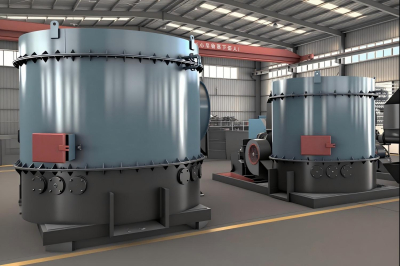
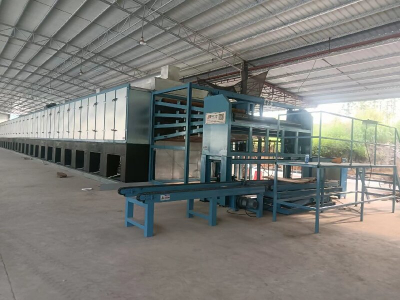
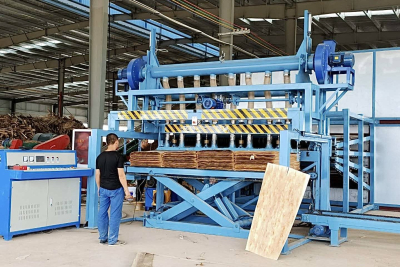
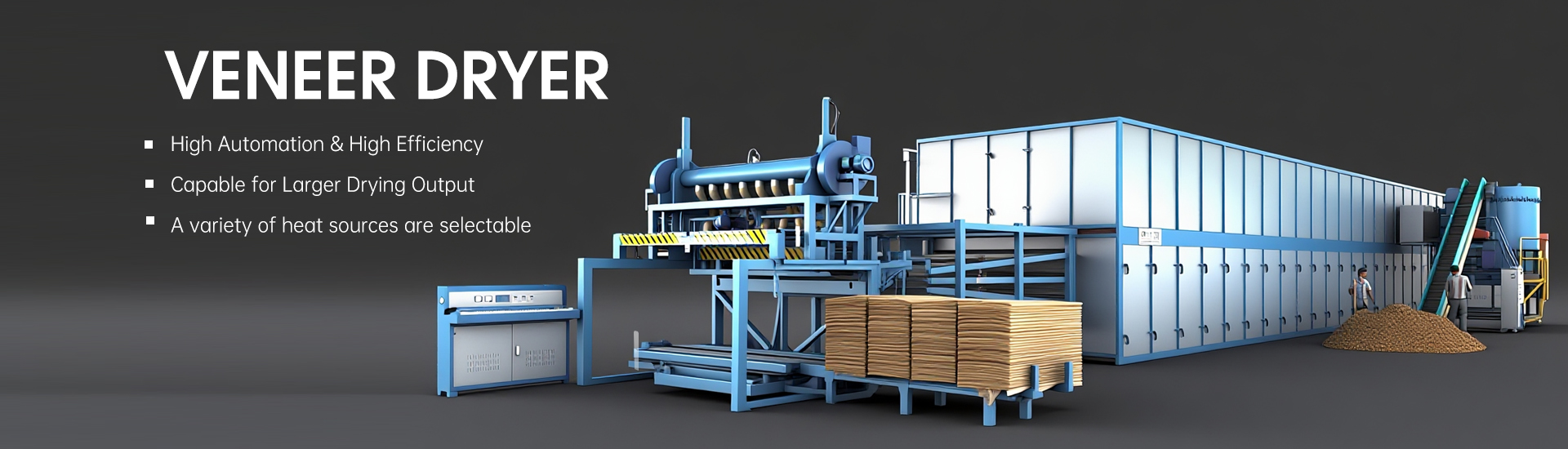
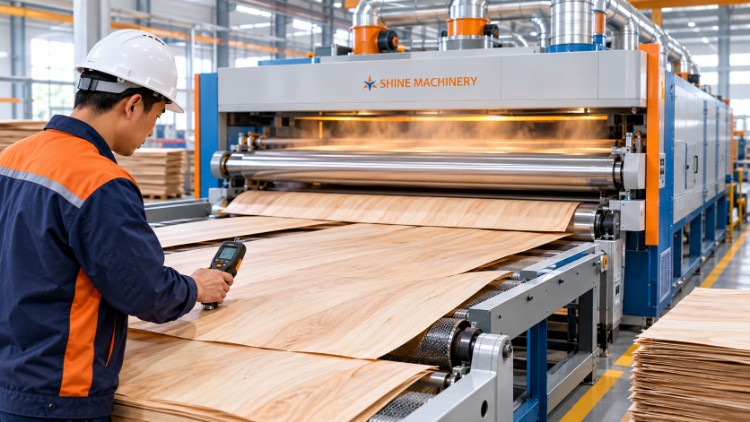
A wood veneer dryer removes water through controlled heat and airflow. The dryer raises veneer temperature while moving hot air across the sheets. This process encourages water inside the wood to migrate toward the surface.
A modern veneer dryer must control more than temperature. Air velocity, residence time, heating method, and exhaust conditions also influence the result.
Our approach focuses on stable drying rather than simply increasing heat. Higher temperature can shorten drying time, but it can also affect surface properties and veneer quality.
Heat, Airflow, and Moisture Removal
During drying, several core components work together:
Heating system
Circulation fans
Dryer decks
Rollers or mesh belts
Exhaust system
Temperature controls
Moisture monitoring equipment
Hot air carries moisture away from the veneer surface. Meanwhile, moisture moves from the inside toward the surface.
Dry air can improve the moisture removal rate. However, the system must maintain enough airflow without creating excessive energy consumption.
What Happens Before Hot Pressing?
The moisture target becomes especially important before gluing and hot pressing. Veneer should have a reasonably uniform moisture level across the sheet and through the production batch.
Uneven drying can create wet spots and overdried areas. These differences may affect glue spreading and final panel strength.
Research on plywood manufacturing has reported a practical target around 6%–8% for many applications. It also notes that higher moisture can contribute to defects during hot pressing.
Why Uniform Moisture Matters
Imagine stacking hundreds of veneer sheets. Some contain 5% moisture, while others contain 11%. The glue line will not behave consistently.
Uniform moisture helps improve:
Adhesive performance
Pressing consistency
Panel stability
Production efficiency
Finished product quality
Therefore, we do not judge drying success from one sheet alone. We look at moisture distribution across the production batch.
Equilibrium Moisture Content Also Matters
Equilibrium moisture content, or EMC, describes the moisture level wood reaches under specific temperature and humidity conditions. Wood gains or loses moisture until it reaches balance with its surrounding environment.
For example, wood exposed to higher relative humidity generally reaches a higher EMC. Therefore, dried veneer can absorb moisture again after leaving the dryer.
This point often surprises new operators. You can dry veneer perfectly today, then store it in humid air and watch the moisture rise again.
Control Storage After Drying
After veneer drying, factories should protect the material from uncontrolled humidity. Good practices include:
Keep veneer away from rain and condensation.
Avoid direct contact with wet floors.
Maintain stable warehouse conditions.
Check moisture before gluing.
Cover veneer during long storage.
Avoid unnecessary exposure to humid air.
A moisture meter can help operators catch changes early. The USDA also emphasizes moisture control during storage and use because wood continuously responds to its environment.
How We Choose the Right Drying Target
At Shine Machinery, we believe the correct moisture target starts with the customer's product. A face veneer for furniture may need a different target from a core veneer for structural plywood.
We also consider adhesive type, veneer thickness, veneer species, dryer configuration, production speed, and local climate. This approach helps us balance veneer quality, production capacity, and operating cost.
A practical process looks like this:
Test the initial moisture content.
Confirm veneer thickness and species.
Define the adhesive and final product.
Set an initial drying target.
Measure moisture after drying.
Check moisture uniformity.
Adjust temperature and airflow.
Recheck the veneer before gluing.
This method gives operators useful data instead of relying on a single temperature or drying time.
Final Answer: What Moisture Content Should Veneer Have?
For many plywood applications, 6%–8% moisture content provides a practical target. Decorative face veneer often uses about 8%–10%, while some phenolic hot-press applications require 5% or lower.
Still, the best target depends on the complete veneer production process. Wood species, thickness, adhesive, storage conditions, and dryer design can all change the result.
We recommend measuring the veneer rather than relying only on dryer settings. With proper moisture control, a Veneer Dryer Machine can help producers achieve stable drying, consistent bonding, and high-quality wood products.
The key lesson is simple: dry veneer enough for its application, but never dry it blindly.