How to Improve Veneer Drying Quality
Freshly peeled veneer contains a surprising amount of water. If we dry it poorly, the next production step can become a headache.
Good drying does more than remove moisture. It helps us produce flat veneer with stable moisture and good bonding performance. For this reason, we treat drying as a key step in plywood production.
So, how to improve veneer drying quality? We need to control several factors together. These include moisture content, temperature, airflow, drying time, veneer thickness, and wood species.
What Is Veneer Drying Quality?
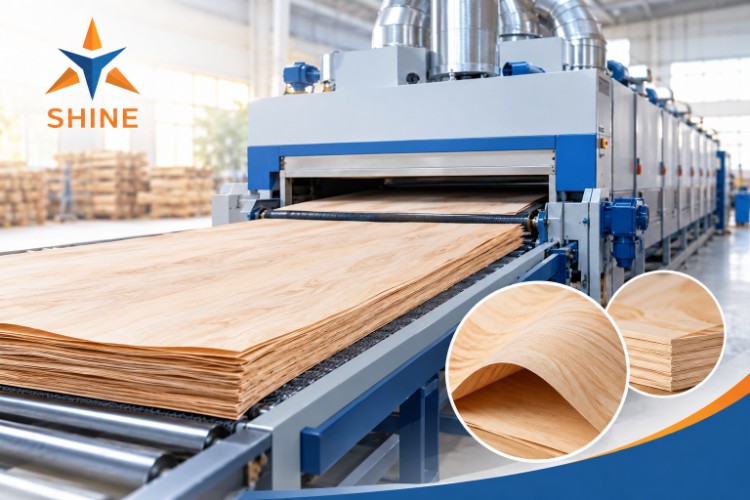
Good drying quality means more than simply making wet veneer dry. We want the veneer to reach a suitable and even moisture content without excessive cracking, warping, or brittleness.
The U.S. Forest Products Laboratory describes three main drying goals: fast drying, flat veneer, and uniform moisture suitable for gluing. This simple idea still matters in modern plywood production.
Look Beyond Final Moisture
A sheet may show the right average moisture content and still have problems. One area may remain wet while another becomes too dry. That difference can affect gluing, pressing, and final panel quality.
We therefore look at both the average moisture content and its uniformity. A stable result usually matters more than simply chasing the fastest drying speed.
Control Veneer Moisture Content
Moisture control sits at the heart of veneer drying. Fresh veneer can contain a large amount of water, depending on the species, log condition, and peeling process.
Our goal is not to remove every drop of water. Instead, we need to reach the moisture range required by the next production stage.
Set a Clear Moisture Target
The target depends on the wood species, veneer thickness, adhesive, and plywood application. Some industrial references report target moisture ranges around 6%–20%, while other plywood processes commonly target lower ranges.
We recommend defining the target before setting the dryer. Then, operators can adjust temperature, airflow, and conveyor speed around that target.
Most importantly, avoid two extremes:
Too much moisture: bonding and hot pressing may suffer.
Too little moisture: veneer can become brittle.
Uneven moisture: different sheets may behave differently during pressing.
Set the Right Veneer Drying Temperature
Temperature provides the heat needed to move moisture out of the wood. However, hotter does not always mean better.
Industrial systems commonly operate at elevated temperatures. Yokogawa reports 130–200°C for a controlled veneer drying process, with air humidity around 30%–40% in its application example.
Match Temperature to the Material
We should adjust the veneer drying temperature according to thickness, species, initial moisture, and dryer design. Thin veneer usually responds faster than thick veneer.
Research also shows that drying temperature can affect plywood bonding and mechanical properties. One study tested birch veneer at temperatures from 160°C to 280°C and found significant effects on several plywood properties.
Therefore, we should never copy a temperature setting blindly. The best setting is the one that achieves stable moisture without damaging the veneer.
Ensure Uniform Veneer Drying
Uniform drying is one of the biggest challenges in commercial production. Veneer varies naturally in thickness, density, moisture, and structure.
The dryer must therefore provide consistent heat and airflow across the sheet. Otherwise, some areas may dry quickly while others remain wet.
Balance Heat and Airflow
Hot air transfers heat to the veneer surface. Airflow then helps carry evaporated moisture away.
A good system needs both.
We pay close attention to:
Air velocity
Air temperature
Air humidity
Dryer zone temperature
Veneer thickness
Conveyor speed
Exhaust conditions
Modern systems can divide the dryer into different zones. This approach allows operators to adjust drying conditions more precisely.
Control Drying Time and Airflow
Drying time depends on more than the clock. Veneer thickness, wood species, initial moisture, temperature, airflow, and target moisture all play a role.
If we move veneer too quickly, it may leave the dryer before reaching the target. If we move it too slowly, we waste energy and production capacity.
Adjust Conveyor Speed
For a continuous wood veneer dryer, conveyor speed directly affects residence time. A small speed change can influence final moisture.
We usually recommend checking the actual moisture result after changing speed. Do not judge the setting by machine speed alone.
In other words, fast is useful only when the veneer is still good. Otherwise, we are simply producing bad veneer faster.
Prevent Common Veneer Drying Defects
Poor drying can create several visible and hidden problems. Common defects include cracks, warping, wrinkles, uneven moisture, discoloration, and excessive brittleness.
These problems often come from poor parameter matching rather than one single machine fault.
Avoid Over-Drying and Under-Drying
Over-dried veneer can become brittle and harder to process. Under-dried veneer can retain too much moisture for effective bonding.
Humidity control also matters because drying air conditions affect moisture removal. Vaisala notes that moisture variation can result from raw wood differences, drying-air humidity, dryer loading, and temperature changes.
We therefore recommend monitoring the process instead of relying only on fixed settings.
Choose the Right Wood Veneer Dryer
The right equipment should match the production target. A small plywood factory may have very different requirements from a large automated veneer line.
When selecting a wood veneer dryer, we suggest checking several technical points first.
Check These Key Parameters
Consider:
Veneer thickness range
Wood species
Initial moisture content
Target moisture content
Production capacity
Drying temperature
Airflow design
Number of drying decks
Conveyor speed
Heat source
Energy consumption
Moisture control system
Automatic feeding and collection
We also recommend asking the manufacturer for actual production references. Numbers on a brochure look nice, but real veneer tells the truth.
At Shine Machinery, we focus on matching the dryer design with the customer's veneer type and production conditions. This approach helps us avoid a common mistake: buying a machine first and solving the drying problem later.
How Better Drying Improves Plywood Quality
Drying quality directly affects what happens after the dryer. Veneer needs suitable moisture before gluing and hot pressing.
Research confirms that veneer drying conditions can influence plywood bonding, bending strength, and other panel properties.
Build Quality From the Drying Stage
When moisture stays within the required range, the next processes become easier to control. Glue application becomes more stable, and hot pressing becomes more predictable.
Better drying can also reduce waste caused by cracked, warped, or excessively dry veneer. In turn, this can improve material yield and production efficiency.
We see veneer drying as a foundation, not an isolated process. When the foundation is stable, the rest of the plywood line has a much easier job.
Final Tips for Better Veneer Drying
If you want to improve veneer drying quality, start with the basics. Measure the veneer, understand the material, and then adjust the dryer.
Our practical checklist is:
Measure initial moisture content.
Set a clear final moisture target.
Choose a suitable drying temperature.
Maintain stable airflow.
Control drying-air humidity.
Adjust conveyor speed carefully.
Check moisture uniformity.
Inspect veneer for cracks and warping.
Record drying results.
Fine-tune the process for each wood species.
A good dryer should not simply make veneer dry. It should help us make consistent, flat, stable, and glue-ready veneer.
That is the real meaning of better drying quality.