Optimizing Hot Press Tonnage for Plywood Density
In the high-stakes world of engineered wood manufacturing, the pursuit of perfection is relentless. For plywood producers, the ultimate measure of quality often boils down to one critical metric: density. High-density plywood is synonymous with superior strength, enhanced screw-holding capacity, and exceptional durability. However, achieving the perfect density is not merely a matter of chance; it is a precise science governed by the interplay of heat, time, and pressure. At the heart of this equation lies the plywood hot press, a machine whose tonnage settings dictate the very essence of the final product. Understanding the relationship between hot press pressure tonnage and plywood density is crucial for any manufacturer aiming to optimize their production line and deliver premium-grade panels.
The fundamental principle at work is compression mechanics. When a stack of veneers, or "lay-up," enters the plywood hot press, the machine applies immense force to consolidate the layers. This force, measured in tons, determines the total pressure exerted on the panel. Within a specific range, there is a direct and proportional relationship between the pressure tonnage applied and the resulting density of the plywood. Higher tonnage forces the wood fibers to compress, reducing the volume of air pockets and interstitial spaces between the veneers. This compaction increases the mass per unit volume, thereby elevating the density. For instance, to transform a standard sheet of birch plywood into a high-density industrial-grade panel, a manufacturer must significantly increase the pressure settings on their plywood making machine to ensure the wood fibers interlock tightly.

However, the relationship is not a simple linear progression but rather a nuanced balance. The effectiveness of pressure tonnage is intrinsically linked to the type of wood being processed. Different wood species possess varying natural densities and cellular structures. Softwoods like pine or cedar have larger, more compliant cells that compress relatively easily under lower pressures. In contrast, hardwoods such as oak, beech, or tropical species have denser, more rigid cell structures. To achieve a comparable increase in density with these harder species, a substantially higher pressure tonnage is required. Producers must calibrate their equipment based on the specific gravity of the raw materials to avoid under-compression, which leads to weak boards, or over-compression, which can cause structural damage to the wood fibers.
Moreover, the magic of the plywood hot press lies in its ability to combine heat with pressure. Temperature acts as a catalyst for plasticity. When wood is heated, its primary component, lignin, softens. This thermoplastic behavior allows the wood fibers to become more malleable and deform under pressure. Therefore, a plywood making machine operating at a higher temperature can achieve a higher density at a slightly lower pressure tonnage compared to a cold press. This synergy between heat and pressure is why hot pressing is the industry standard for producing high-quality, dense plywood. The typical operating temperature range of 100°C to 140°C is carefully chosen to maximize lignin softening without degrading the wood or the adhesive.
The calculation of required tonnage is a critical step in the manufacturing process. It is not enough to simply increase the pressure; manufacturers must calculate the exact force needed based on the desired density and the surface area of the panel. The formula involves multiplying the desired unit pressure (measured in Megapascals or MPa) by the total platen area. For example, producing a high-density hardwood panel might require a unit pressure of 1.8 to 2.5 MPa. For a standard 4x8 foot sheet, this translates to a total pressure requirement of over 500 tons. Selecting a plywood hot press with insufficient tonnage capacity will result in panels that fail to meet density specifications, regardless of how long they are pressed.
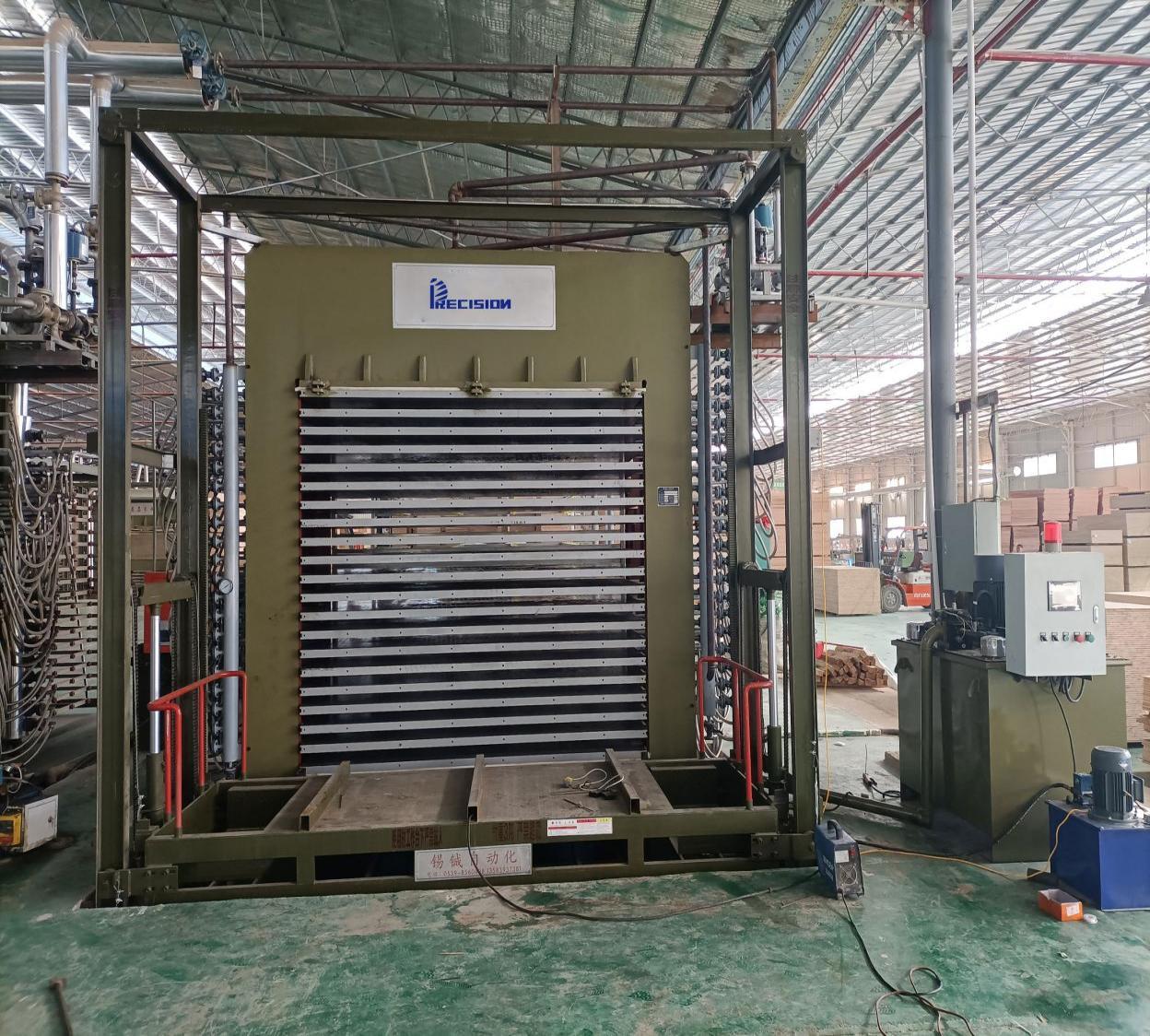
Beyond the raw numbers, the rate at which pressure is applied also plays a role. A rapid closure speed ensures that the heat penetrates the core of the panel before the surface adhesive cures, allowing for uniform compression throughout the thickness. This prevents density gradients within the panel, which can lead to warping or internal delamination. Advanced plywood making machine models feature programmable logic controllers (PLCs) that allow operators to fine-tune the pressure application curve, ensuring optimal density distribution.
In conclusion, the pressure tonnage of a plywood hot press is the primary lever for controlling plywood density. By understanding the material properties of the wood, leveraging the plasticizing effect of heat, and applying precise calculations, manufacturers can consistently produce high-density panels. This knowledge empowers producers to move beyond guesswork, utilizing their plywood making machine to its full potential to create products that meet the rigorous demands of modern construction and industrial applications. As the industry evolves, the mastery of pressure dynamics will continue to be a defining factor in the quest for superior plywood quality.