When was Plywood First Used in Germany
If you ask, “When was Plywood First Used in Germany?”, the answer needs a little context. Germany played an important role in plywood history before the famous 1865 American patent. In fact, German makers had already explored layered wood construction decades earlier.
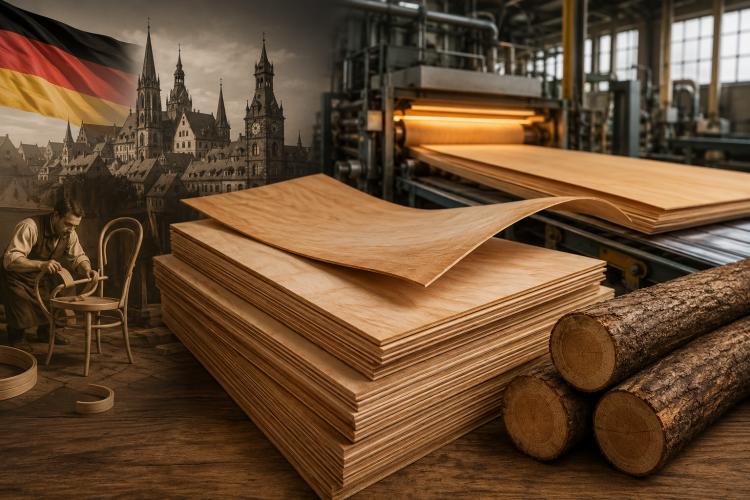
The story reaches back to the 19th century. Around 1830, German cabinetmaker Michael Thonet used laminated wood techniques for bent furniture. Later, Bruno Harras established what German historical sources describe as the world's first plywood factory in Böhlen, Thuringia, in 1858.
So, Germany did not simply “adopt” plywood after its American patent. German craftsmen and manufacturers had already developed practical applications. That makes the history far more interesting than a single invention date.
Germany Before the 1865 Plywood Patent
Modern plywood consists of several layers of veneer. Each layer can run in a different grain direction. This cross-layer design improves strength and limits movement caused by moisture.
German furniture makers understood the value of thin wood layers early. They worked with bent and laminated wood for furniture. The result offered shapes that solid wood could not easily achieve.
Michael Thonet became especially important in this story. His work in the early 19th century helped demonstrate how thin wood layers could become strong, useful forms. It was a clever solution to a stubborn woodworking problem.
The 1858 Factory Changed the Story
The year 1858 deserves special attention. German historical sources credit Bruno Harras with founding the world's first plywood factory in Böhlen, Thuringia. That date comes before the well-known American patent of 1865.
This factory marked an important shift from craft production toward industrial veneer production. Instead of treating thin wood layers as a decorative trick, manufacturers could treat them as an engineered wood panel.
That shift mattered. Once production became more organized, plywood could serve furniture, vehicles, interiors, and eventually construction.
What Happened on December 26, 1865?
The date December 26, 1865, often appears when people search for the birth of modern plywood. On that day, John K. Mayo of New York City received a patent for a plywood-like material.
However, the patent does not prove that plywood began in Germany in 1865. It shows something different. It formalized a cross-laminated wood concept in the United States, giving the material an important legal and technical milestone.
John K. Mayo and Cross-Grain Construction
Mayo described joining several thin wood sheets. He also emphasized changing the grain direction between layers. This approach created greater strength and reduced splitting and dimensional movement.
His idea sounds familiar today because the basic principle remains relevant. Plywood still relies on carefully arranged layers of veneer. In simple terms, wood fibers work together instead of fighting each other.
Interestingly, Mayo did not turn the patent into a major commercial success. That reminds us of something every manufacturer learns sooner or later. A good invention still needs good production, marketing, and customers.
Germany and the United States Took Different Paths
The United States later developed a powerful industrial plywood sector. The 1905 Portland World's Fair helped promote softwood plywood made from Pacific Northwest timber. Manufacturers used Douglas-fir to create what they called “3-ply veneer work.”
The American industry eventually standardized sizes and production methods. By 1928, standard 4 × 8 ft plywood sheets had entered the market. This helped plywood become a practical construction material.
Germany followed its own path. Its earlier experience with laminated wood and furniture helped build a foundation for later engineered wood production.
How Plywood Manufacturing Became Industrial
Early laminated wood products could rely heavily on skilled workers. Modern plywood manufacturing requires much tighter process control. Each stage affects the final strength, appearance, and stability of the plywood panels.
Today, the process usually begins with logs. Workers sort and condition the timber before peeling or slicing it into thin sheets of wood veneer. These sheets then move through drying, grading, repair, gluing, lay-up, pressing, trimming, and finishing.
For us, veneer quality remains one of the most important factors. A beautiful log cannot rescue poor process control. Wood has a funny habit of exposing mistakes later.
From Logs to Face Veneers
Manufacturers first prepare logs for veneer production. Heat and moisture can soften the wood before rotary peeling. This preparation helps create more consistent veneer sheets.
The resulting veneers need careful grading. Manufacturers may select attractive face veneers for the outer surfaces. Inner layers can use other grades because appearance matters less there.
A typical plywood structure may include:
Face veneer
Core veneer
Crossband veneer
Back veneer
Adhesive layers
The grain direction changes between layers. This structure gives plywood useful strength in several directions.
Why Veneer Drying Matters
Fresh veneer contains a large amount of moisture. Manufacturers must control that moisture before gluing and pressing. Otherwise, production can suffer from bonding problems, deformation, or quality defects.
Traditional mills sometimes air-dried veneer. Modern plants often use continuous dryers or batch kilns for better control. FAO notes that controlled drying can improve uniformity while reducing handling damage.
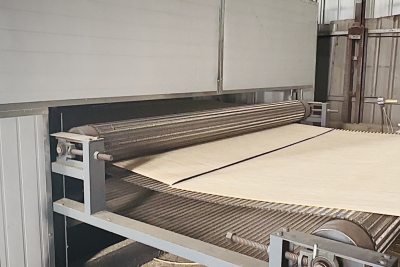
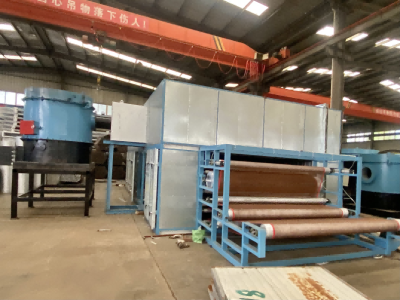
A modern wood veneer dryer therefore does much more than remove water. It helps prepare veneer for the next manufacturing stage. Good veneer drying supports stable bonding and reliable panel quality.
Why Drying and Hot Pressing Matter
Drying represents a major energy challenge in plywood production. FAO estimates that veneer drying can account for about 70% of thermal energy consumption in plywood production. It can also represent roughly 60% of total mill energy requirements.
That makes energy consumption an important production target. Manufacturers want fast drying, stable moisture, low waste, and reasonable fuel use. These goals must work together.
At our company, we see this balance every day. Faster does not always mean better. The best process gives the veneer enough heat and airflow without creating unnecessary defects.
Hot Pressing Turns Veneer Into Panels
After drying, workers apply adhesive and arrange the veneers. The grain direction changes between layers. This arrangement creates the familiar cross-laminated structure.
Next comes hot pressing. Heat and pressure help the adhesive bond the layers into a stable panel. Pressure must remain consistent across the panel to achieve reliable results.
A simplified process looks like this:
Log → Peeling → Veneer Drying → Grading → Gluing → Lay-Up → Hot Pressing → Trimming → Sanding → Inspection
Every stage connects with the next. A problem during drying can appear later as a pressing or bonding problem.
High Quality Starts Before the Press
Many buyers focus on the press because it looks impressive. We understand why. Huge presses squeezing layers of wood together certainly make a memorable factory scene.
Yet high-quality plywood starts much earlier. Veneer thickness, moisture content, surface condition, adhesive spread, and lay-up accuracy all matter.
For example, poorly dried veneer can create inconsistent bonding. Excess moisture can also increase drying time during later stages. Good production therefore treats moisture control as a core quality step.
Plywood During the 20th Century
The 20th century transformed plywood from a specialized material into a major engineered wood product. Construction, transportation, furniture, packaging, and aircraft manufacturing all found useful applications.
Softwood plywood became especially important. APA notes that construction plywood made from softwood species did not become common until the 20th century.
This development expanded plywood far beyond decorative furniture. It became one of the practical building materials used across modern industries.
World War II Pushed Plywood Forward
World War II created huge demand for lightweight and efficient materials. Plywood offered an attractive combination of strength, low weight, and workable manufacturing.
The famous de Havilland Mosquito provides one of the best examples. Britain built this aircraft with extensive wooden construction, including plywood and balsa-based composite structures. The design became famous for its speed and versatility.
The Mosquito was not a German aircraft. However, its story shows how far plywood technology had progressed by the war years. Plywood had moved from furniture workshops into advanced engineering.
German Aircraft Also Used Plywood
Germany also used plywood in wartime aircraft development. The Heinkel He 162 provides one example of German aircraft construction involving wood. German plywood production therefore formed part of a much larger European engineering story.
The war accelerated material innovation. Manufacturers needed materials that saved weight, reduced metal use, and supported rapid production.
Plywood checked several of those boxes. It was not perfect, but few materials are.
Plywood Today: From History to Modern Production
Today, plywood serves a huge range of markets. It appears in furniture, flooring, packaging, transportation, walls, roofs, and many other applications.
Manufacturers can choose different wood species, adhesives, veneer grades, and panel structures. Softwood plywood works well in many structural applications. Hardwood plywood often focuses more on appearance and furniture applications.
Compared with solid wood, plywood also offers useful dimensional stability. Its cross-layer structure helps reduce some problems linked to expansion and contraction.
Modern Veneer Drying Saves More Than Time
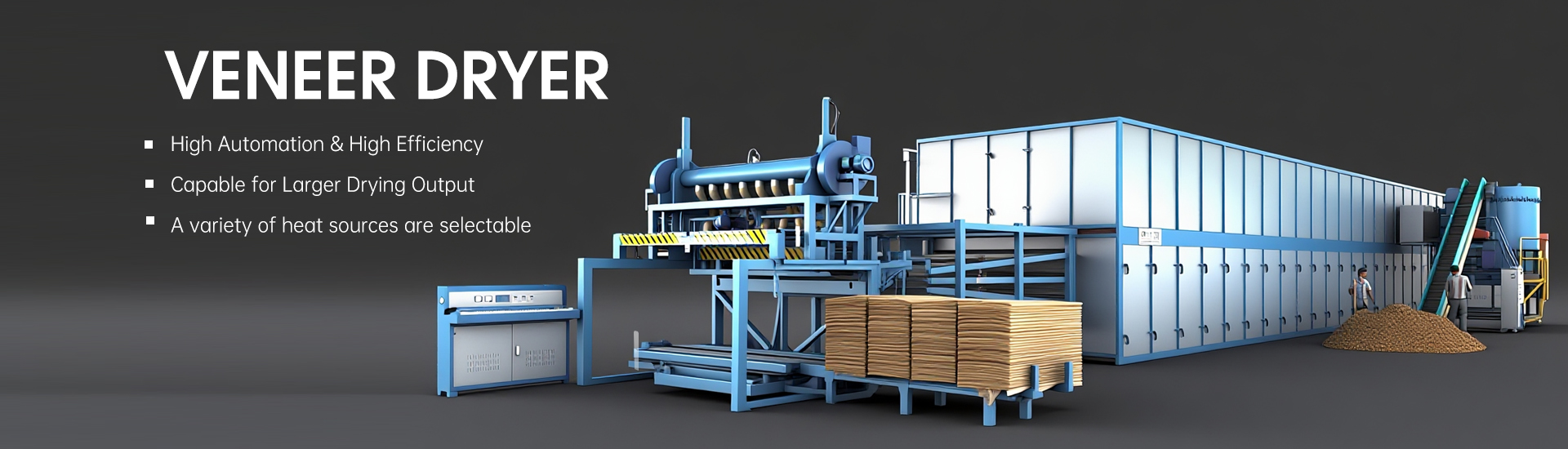
Today's plants pay close attention to dryer design. Uniform drying can improve veneer quality and support more consistent downstream production.
A modern Veneer Dryer Machine can use controlled airflow, heat, and conveyor systems to manage the drying process. The exact design depends on wood species, veneer thickness, production capacity, and target moisture content.
From our perspective, the goal is simple:
Stable moisture content
Low veneer damage
Efficient heat transfer
Reduced energy consumption
Continuous production
Consistent final quality
These factors help manufacturers produce dependable plywood at competitive operating costs.
What Germany's Plywood History Teaches Us
The German story offers a useful lesson. Plywood did not appear overnight because one person suddenly had a brilliant idea.
Its development involved furniture makers, veneer technology, adhesives, machinery, pressing systems, and industrial production. Germany contributed early practical work, while the United States later helped develop large-scale commercial plywood manufacturing.
The answer to “When was Plywood First Used in Germany?” therefore depends on what we mean by “used.”
If we mean early laminated wood furniture, Germany was already involved around 1830. If we mean industrial plywood production, German sources point to Bruno Harras and his 1858 factory in Böhlen. If we mean the famous first plywood patent, we reach December 26, 1865, in New York.
That is the twist in the story. The history of plywood has no single birthday.
Conclusion: A Material With Many Beginnings
When we look at plywood today, it can seem almost ordinary. We see panels in buildings, furniture, trucks, factories, and workshops. Yet its history connects ancient laminated wood, German furniture making, American patents, industrial veneer production, and wartime engineering.
Germany played an early and meaningful role. The work of Michael Thonet and the 1858 Böhlen factory show that laminated wood technology had already developed before Mayo's 1865 patent.
For modern manufacturers, that history still matters. The same basic idea remains powerful: thin wood layers can create something stronger and more useful together.
We believe that principle also explains why veneer drying remains so important. Good plywood starts with good veneer. And good veneer starts with controlled, efficient processing.