Why Is Veneer Drying Uneven?
Uneven veneer drying can reduce product quality, increase energy costs, and slow down production. Some sheets leave the dryer too wet, while others become brittle from excessive heat. This problem often points to differences in raw materials, airflow, temperature, or feeding speed. At Shandong Shine Machinery, we believe consistent drying starts with understanding these factors.
A reliable veneer drying process does more than remove water. It prepares each sheet for gluing, hot pressing, and further processing. When manufacturers control moisture carefully, they can reduce waste and improve production efficiency. So, why is veneer drying uneven, and what can you do about it?
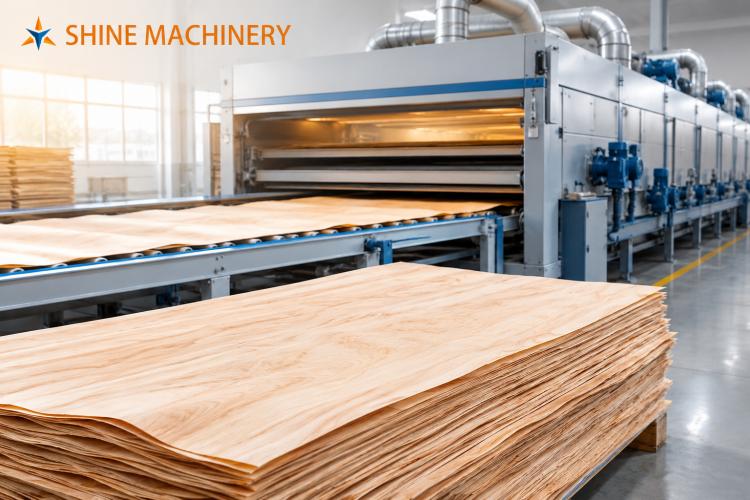
What Does Uneven Veneer Drying Mean?
Uneven drying occurs when veneer sheets reach different moisture levels under the same production conditions. It can also occur within a single sheet, leaving some areas wetter than others. These differences may appear even when the drying line runs continuously. Therefore, operators should examine both individual sheets and entire production batches.
Common Signs of Uneven Drying
You can often identify drying problems by checking the veneer immediately after it exits the dryer. Look for these warning signs:
Wet patches: Certain areas retain more moisture than the surrounding wood.
Brittle edges: Excessive drying makes some sections fragile and easy to break.
Warping or curling: Uneven moisture loss creates internal stress and changes the sheet's shape.
Inconsistent moisture readings: Sheets from the same batch show noticeable differences.
Bonding problems: Excessive or insufficient moisture can affect adhesive performance during plywood production.
Higher rejection rates: More sheets require re-drying, sorting, or disposal.
These symptoms often appear together, but they do not always share one cause. For example, a wet sheet may indicate weak airflow or excessive feeding speed. Brittle edges may instead point to excessive heat or an unsuitable drying schedule.
7 Main Causes of Uneven Veneer Drying
Several factors influence how quickly veneer loses moisture. Understanding their effects helps operators find the real problem instead of making random adjustments.
1. Uneven Initial Moisture Content
Freshly peeled veneer contains water, but its initial moisture content varies. Wood species, log condition, storage time, and peeling conditions all affect moisture distribution. Even sheets from the same log may enter the dryer with different moisture levels.
When operators mix very wet and relatively dry sheets, the dryer faces different demands. Some sheets need more time to release water, while others reach their target earlier. One fixed setting may not produce consistent results across every sheet.
How to improve consistency:
Check initial moisture levels across representative samples.
Separate batches when moisture differences become significant.
Group veneer by wood species and thickness when practical.
Avoid unnecessary delays between peeling and drying.
Adjust drying parameters according to actual material conditions.
At our company, we encourage manufacturers to consider raw material consistency before changing equipment settings. A well-managed production process begins before the veneer enters the dryer.
2. Poor Airflow Distribution
Airflow plays a major role in veneer drying. Hot air transfers heat to the wood surface and carries away released moisture. When air reaches some areas more effectively than others, drying rates become inconsistent.
For example, sheets near a strong airflow path may dry faster than sheets in weaker circulation zones. Blocked air passages, dirty filters, damaged fans, and poor air distribution can make this problem worse.
A veneer dryer machine needs balanced airflow to deliver consistent results. Simply increasing fan speed may not solve the issue. In some cases, operators must identify blocked passages or correct an imbalance between different dryer sections.
Practical troubleshooting steps:
Inspect fans, filters, ducts, and air outlets regularly.
Check for unusual noise or vibration from circulation fans.
Compare moisture readings across different dryer positions.
Remove material buildup that restricts air movement.
Ask qualified technicians to inspect airflow balance when problems persist.
Modern drying technology can improve air distribution across multiple decks and dryer zones. However, regular maintenance remains essential for reliable operation.
3. Inconsistent Temperature Across Dryer Zones
Temperature affects how quickly water leaves the veneer. Excessive heat can accelerate surface drying, increase brittleness, and contribute to quality defects. Insufficient heat may leave some sheets too wet when they exit the machine.
A continuous drying line often uses several zones with different operating conditions. Each zone contributes to moisture removal in a different way. If one zone operates outside its intended range, the entire drying process may become less consistent.
Temperature differences can result from faulty sensors, uneven heat distribution, burner problems, or unstable heat supply. Operators should investigate these issues before making large temperature changes.
How to improve temperature control:
Record temperature readings from each dryer zone.
Compare actual readings with the recommended operating settings.
Inspect temperature sensors and control systems.
Check the heating system for unstable output.
Adjust zone settings gradually and monitor the results.
The correct temperature depends on wood species, veneer thickness, initial moisture, and equipment design. There is no single setting that suits every production line.
4. Incorrect Feeding Speed
Conveyor speed determines how long each sheet remains inside the dryer. If the line moves too quickly, the veneer may leave before reaching its target moisture content. If the line moves too slowly, some sheets may overdry and waste energy.
Problems become more noticeable when manufacturers change veneer thickness or process wetter raw materials. A speed setting that works for one batch may not work for another. Operators should therefore treat feeding speed as part of a complete drying strategy.
Recommended actions include:
Measure moisture content at the dryer exit.
Compare results at different conveyor speeds.
Check whether wet sheets cluster during high-speed operation.
Adjust speed in small steps rather than making sudden changes.
Coordinate speed adjustments with temperature and airflow settings.
A stable production speed should balance drying quality, output, and energy use. Faster operation does not automatically mean better productivity.
5. Different Veneer Thicknesses and Wood Species
Not all veneer sheets respond to heat in the same way. Thick sheets generally require different drying conditions from thin sheets. Wood species also differ in density, structure, and moisture movement.
When operators process mixed materials without suitable adjustments, some sheets may dry faster than others. This can happen even when airflow and temperature remain stable.
For example, a dryer setting designed for thin, easy-to-dry veneer may not suit thicker sheets. Similarly, dense wood may respond differently from lighter wood under identical conditions.
To reduce material-related differences:
Measure veneer thickness regularly.
Separate materials when their drying requirements differ substantially.
Establish suitable operating recipes for common species.
Record results from previous production batches.
Recheck settings whenever the raw material changes.
These steps help operators make informed adjustments instead of relying on guesswork. They also support more predictable veneer production.
6. Excessive Loading or Poor Sheet Feeding
The way operators feed veneer into the dryer can influence airflow and heat transfer. Overlapping sheets, irregular spacing, and incorrect alignment may prevent hot air from reaching every surface evenly.
Excessive loading can also increase the demands on the heating and circulation systems. As a result, some areas may dry more slowly than expected.
Even a well-designed machine cannot compensate for every feeding problem. Operators should follow the equipment manufacturer's loading recommendations and keep the material flow stable.
Check these points during production:
Feed sheets in the correct direction.
Prevent unnecessary overlap and irregular spacing.
Keep conveyor paths clean and unobstructed.
Check whether sheets travel smoothly through each section.
Maintain consistent loading across the working width.
Good feeding practices improve drying consistency and help the machine operate closer to its intended capacity.
7. Poor Moisture Monitoring and Control
A dryer may appear to operate normally while producing inconsistent moisture levels. Without reliable measurements, operators may miss the early signs of a problem.
Visual inspection alone cannot reveal the exact moisture content of every sheet. A veneer surface may look dry while retaining excessive moisture inside. Another sheet may appear acceptable but become brittle during handling.
Moisture monitoring gives operators better information for adjusting the drying process. Depending on the production line, manufacturers can use handheld meters, sampling procedures, or online measurement systems.
A practical monitoring routine should include:
Checking representative sheets from each production batch.
Measuring moisture at different positions across the working width.
Recording results alongside temperature and conveyor speed.
Comparing readings from different dryer zones or operating periods.
Investigating repeated variations instead of correcting individual sheets alone.
Online monitoring can provide useful feedback for process control. When operators connect moisture readings with operating data, they can identify patterns and make better decisions.
How to Diagnose Uneven Drying Step by Step
When uneven drying appears, changing several settings at once makes troubleshooting difficult. We recommend a structured approach that connects visible defects with measurable operating conditions.
Step 1: Identify the Pattern
First, determine whether the problem affects individual sheets, one section of the dryer, or the entire production batch. Check whether wet areas appear consistently on the same side or at the same position.
This information can help distinguish material problems from airflow or equipment problems.
Step 2: Measure Moisture Content
Collect representative samples from the dryer exit. Measure several sheets rather than relying on one reading. Record the results and compare them with your production requirements.
The target moisture content depends on the intended application, adhesive system, wood species, and manufacturing conditions. Always follow the specifications for your product.
Step 3: Review Operating Data
Check temperature, conveyor speed, fan operation, and available humidity measurements. Compare current readings with stable production records. Look for changes that occurred around the time the problem started.
For example, a sudden increase in wet sheets may coincide with a raw material change or reduced airflow.
Step 4: Adjust One Variable at a Time
Make controlled adjustments and observe the results. Changing temperature, speed, and airflow simultaneously makes it difficult to identify the effective solution.
Allow enough production time to evaluate each change. Record both the settings and the resulting moisture measurements.
Step 5: Confirm the Results
Continue sampling after the adjustment. Check whether moisture variation decreases across sheets and batches. Also inspect the veneer for brittleness, cracking, and warping.
A successful adjustment should improve consistency without creating new quality problems.
How Can Better Drying Technology Improve Consistency?
A suitable dryer design can help manufacturers manage temperature, airflow, and material movement more effectively. However, the best solution depends on production capacity, raw materials, fuel availability, and product requirements.
At Shandong Shine Machinery, we believe manufacturers should evaluate the complete drying system rather than focus on one component. Consistent results depend on the interaction between equipment design, process settings, and daily operation.
Balanced Air Circulation
A well-designed air circulation system distributes heat more evenly across the drying area. This reduces differences between sheets that travel through different positions. Regular maintenance helps preserve that balance over time.
Zoned Temperature Control
Independent control across dryer zones allows operators to adapt conditions during different drying stages. This flexibility can help manage moisture removal without exposing every sheet to the same conditions throughout the entire process.
Reliable Moisture Monitoring
Moisture measurement helps operators identify underdrying and overdrying before these problems affect larger batches. Online monitoring can provide continuous feedback, while manual sampling offers a practical option for smaller operations.
Energy-Efficient Operation
A resource efficient drying system removes moisture without wasting excessive heat or processing time. Balanced airflow, suitable operating settings, effective insulation, and consistent feeding all contribute to better energy use.
Manufacturers should assess energy consumption alongside product quality and production output. The lowest energy use per hour does not always mean the lowest cost per acceptable sheet.
Common Mistakes to Avoid
Some troubleshooting methods can make uneven drying worse. Before changing your production settings, watch for these common mistakes.
Increasing temperature immediately: Higher heat may worsen overdrying without correcting poor airflow.
Slowing the conveyor too much: Longer drying times can waste energy and damage already-dry sheets.
Ignoring raw material differences: Different species and thicknesses may need different operating conditions.
Checking only a few sheets: Small samples may miss important variations across the production width.
Neglecting maintenance: Dirty filters, worn components, and unstable fans can reduce drying performance.
Changing several settings together: Multiple adjustments make it harder to identify the actual cause.
Instead, use measurements, maintenance records, and controlled tests to guide each decision. This approach helps your team solve recurring problems instead of treating the same symptoms every day.
Frequently Asked Questions
Why does one side of veneer dry faster than the other?
Uneven airflow, inconsistent heat distribution, or differences in sheet thickness may cause one side to dry faster. Check moisture readings across the working width and inspect the circulation system.
Can high temperature cause uneven veneer drying?
Yes. Excessive temperature can accelerate moisture loss in some areas and increase the risk of brittleness or other defects. However, low temperature can also leave sheets too wet. Operators should consider temperature alongside airflow, humidity, and conveyor speed.
How do I know whether my veneer is too wet?
Measure moisture content with a suitable meter and compare the results with your production specifications. Visual inspection alone cannot confirm whether a sheet has reached its target moisture level.
Does a better dryer guarantee uniform moisture content?
No single machine can guarantee perfect results under every operating condition. Equipment design, raw material variation, maintenance, and process control all affect the final result. A suitable dryer makes consistent operation easier when operators use it correctly.
How can manufacturers reduce veneer drying costs?
Start by reducing re-drying, overdrying, and avoidable material waste. Maintain stable operating conditions, monitor moisture content, and keep the heating and circulation systems in good condition.
Conclusion: Make Every Sheet Count
Uneven veneer drying rarely comes from one factor alone. Initial moisture, wood species, sheet thickness, airflow, temperature, feeding speed, and monitoring all influence the final result. When manufacturers understand these relationships, they can improve quality without relying on unnecessary temperature increases or longer drying times.
At Shandong Shine Machinery, we recognize that every rejected sheet represents lost material, energy, and production time. Our goal is to help manufacturers achieve stable drying performance through suitable equipment and practical process control. If you are planning a new drying line or improving an existing one, contact our team to discuss your production requirements and explore a suitable solution.