Sun-Dry vs. Machine-Dry Veneer: Which Wins?
In the plywood manufacturing sector, few operational decisions carry as much hidden financial consequence as the choice between traditional open-air sun drying and industrial mechanical veneer drying. For decades, small and medium-sized mills—particularly in tropical and subtropical regions—have relied on natural ventilation and solar radiation to reduce the moisture content of freshly peeled veneers from approximately 50–80% down to the required 6–12%. On the surface, sun drying appears to offer a compelling advantage: zero fuel cost and minimal capital expenditure. However, a closer examination of direct cash outlay, hidden overheads, and quality-related opportunity costs reveals a far more complex picture. As global competition intensifies and product quality standards rise, the economic rationale for investing in a core veneer dryer—typically a roller or mesh belt dryer heated by a biomass burner—deserves rigorous reassessment.
Direct Operating Cost Breakdown
Let us first compare the visible, per-cubic-meter cost of drying green veneer using both methods. In the Chinese plywood-producing belt (e.g., Shandong, Jiangsu, Guangxi), the typical data translates as follows into U.S. Dollar equivalents:
Natural Sun Drying (Air/Sun Method):
Labor (spreading, turning, collecting): RMB ¥20–30/m³ → USD 2.96–4.44/m³
No fuel cost for sunshine.
Direct cash cost: approx. USD 3.00–4.50 per cubic meter of wet veneer processed, excluding land rent, weather-related downtime, and quality loss.
Mechanical Drying – Biomass Roller Veneer Dryer or Mesh Belt Dryer:
Fuel (burning on-site waste wood bark/chips): RMB ¥15–25/m³ → USD 2.22–3.70/m³
Electricity: RMB ¥3–6/m³ → USD 0.44–0.89/m³
Labor (machine tender only): RMB ¥5–10/m³ → USD 0.74–1.48/m³
Direct cash cost: approx. USD 3.40–6.07 per cubic meter when using a biomass burner fueled by in-plant waste.
Mechanical Drying – Electric or Natural Gas Heating (less common):
Total direct cost typically rises to USD 8.86–13.30/m³ ($60–¥90 ÷ 6.76), which is still competitive in regions where land is expensive or biomass is unavailable.
At first glance, the direct cost bands overlap considerably. When a plant already possesses abundant waste veneer, bark, and sawdust to fire a biomass burner, the out-of-pocket drying cost of a modern dryer is virtually identical to—or even slightly lower than—sun drying, once the latter's labor and implicit costs are factored in.
The Hidden Costs of Open-Air Sun Drying
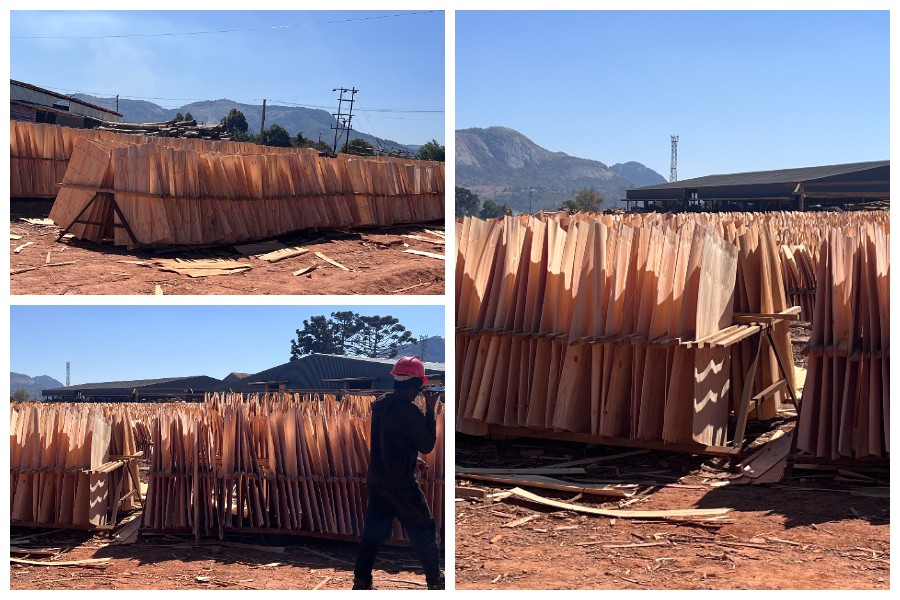
The apparent savings of sun drying evaporate when accounting for its operational disadvantages:
Weather Dependency & Bottlenecks: Rainy seasons, high humidity, or consecutive overcast days can stall drying for days or weeks. Wet veneer backs up, the rotary lathe may have to be throttled or stopped, and downstream pressing lines sit idle. The cost of this lost throughput—often USD 500–2,000 per day in a mid-size plant—far exceeds the few dollars saved per cubic meter.
Extensive Land Requirement: To air-dry 50 m³ of wet veneer per day, a factory typically needs 2,000–3,000 m² of paved, well-drained drying yard. In industrial zones where land may cost USD 30–100/m² or more, this represents a substantial sunk opportunity cost that sun-dried veneer implicitly carries.
Moisture Content Variability & Quality Loss: Sun-exposed tops dry faster than shaded bottoms, creating internal stress that causes curling, end-splitting, and uneven final MC (ranging from 6% to 20% within one batch). Such inconsistency leads to poor glue penetration, blistering, and delamination in the finished plywood. Machine-dried veneer, by contrast, exits the dryer at a uniform 6–10% MC with flat geometry—commanding a premium of USD 14.80–29.60 per cubic meter ($100–¥200 ÷ 6.76) in the marketplace.
Higher Breakage & Handling Loss: Repeated manual flipping and forking of sun-dried stacks result in 2–5% edge-crack waste, versus <1% in automated dryer lines.
Seasonal Limitation & Inventory Tie-Up: Sun drying ties up work-in-progress inventory for 3–15 days versus 5–15 minutes in a dryer, increasing working capital requirements.
Advantages of Mechanical Veneer Dryers
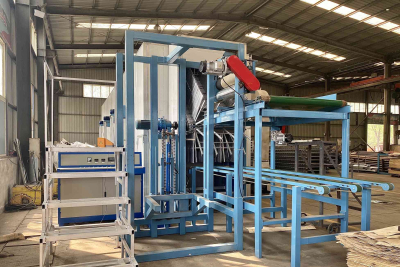
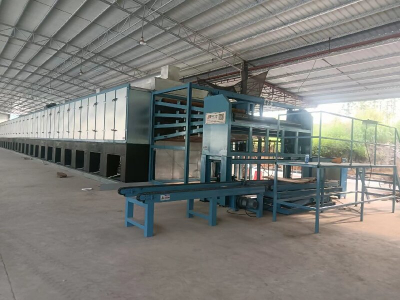
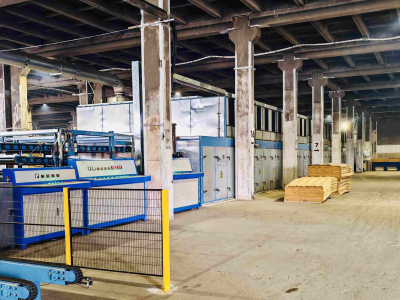
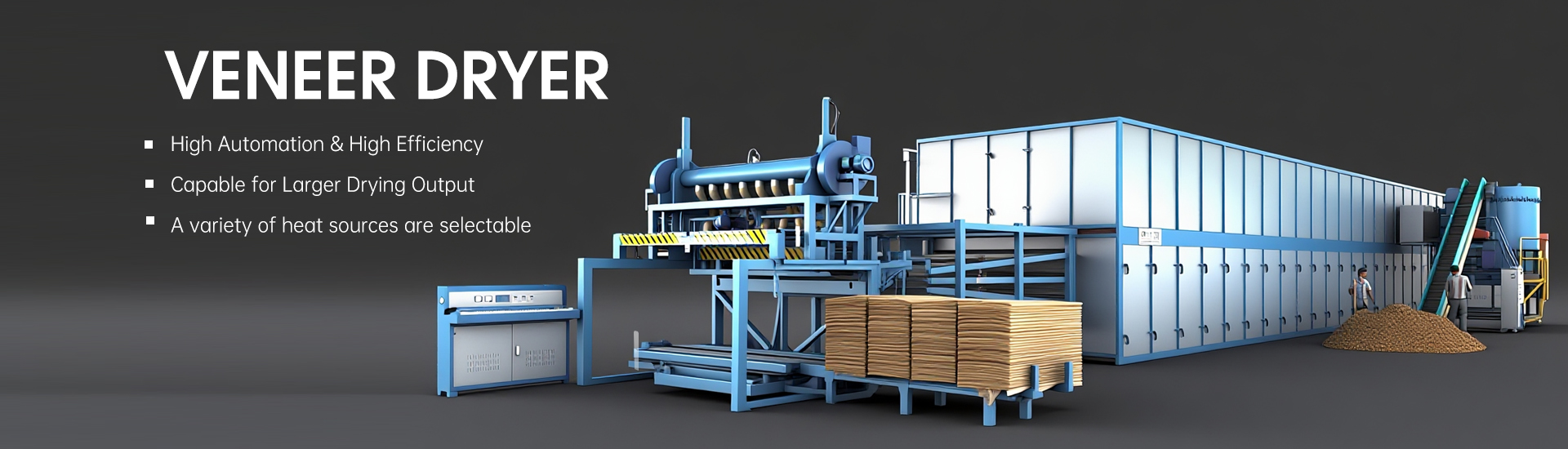
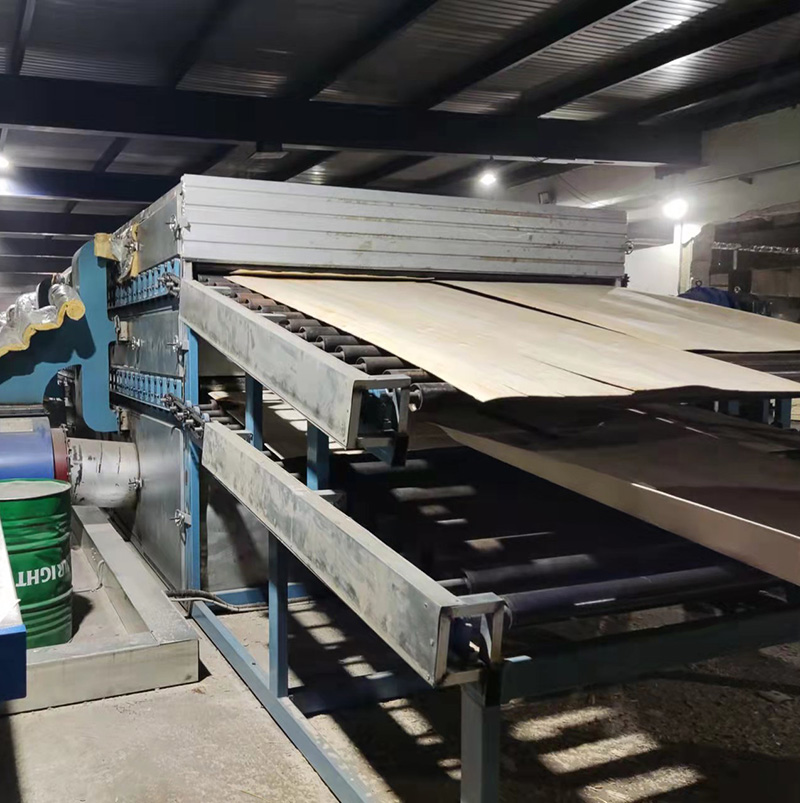
Modern plywood veneer dryers—whether roller type or mesh belt type—transform drying from a weather-dependent variable into a controlled, inline process:
Throughput & Continuity: A single 2-deck or 4-deck roller dryer can process 40–80 m³/24h, perfectly matching the output of a high-speed spindle-less lathe, enabling true continuous-flow production.
Precise Moisture Control: Auto-temperature and frequency-conversion control maintain final MC within ±1%, ensuring consistent gluing performance and reducing reject rates.
Space Efficiency: A dryer line occupies only 60–100 m² of floor space plus a short infeed/outfeed zone, liberating thousands of square meters previously devoted to drying yards for raw material storage or added production lines.
Waste-to-Energy Synergy: Coupling the dryer with an on-site biomass burner consuming bark, black veneer, and off-cuts drives the fuel cost close to zero, making the total cost of ownership highly favorable.
Product Upgrade Pathway: Uniform, flat, low-MC veneer is a prerequisite for producing export-grade film-faced plywood, marine plywood, and LVL—segments that offer markedly better margins than commodity CDX/sheathing panels.
Strategic Recommendation by Plant Profile
Small Artisan Workshops / Arid Climate / Low-End Core-Only Boards: Sun drying may remain viable where land is free, labor cheap, and product grade tolerant of MC variation. Initial CAPEX avoidance is the primary driver.
Medium-to-Large Mills / Continuous Operation / Export or Face-Grade Production: A biomass-heated veneer dryer is strongly recommended. With direct drying costs of USD 3.40–6.07/m³ and superior product quality that yields a 15–30/m³ price premium, the payback period on the dryer investment is frequently under 12–18 months. The elimination of weather-risk downtime and the liberation of drying-yard land further strengthen the ROI case.
Conclusion
While the nominal per-unit drying expense of sun drying (USD ~3.00–4.50/m³) appears marginally lower than that of mechanical drying with biomass (USD ~3.40–6.07/m³), the comparison is incomplete without factoring in land cost, weather disruption, quality degradation, and lost throughput. In a modern, quality-focused plywood operation, the industrial veneer dryer is not a cost adder—it is a cost equalizer that unlocks production continuity, product upgradability, and long-term profitability. As more markets demand certified, consistent panel products, the transition from sun-dried to machine-dried veneer is becoming less a choice of preference and more a prerequisite for competitiveness in the global plywood supply chain.