What Is Rotary Cut Veneer?
What Is Rotary Cut Veneer?
A Simple Definition
What Is Rotary Cut Veneer? It is wood veneer produced by peeling a log continuously on a rotary lathe. The machine rotates the log against a fixed knife. This process creates a long, continuous sheet that looks like unrolling a roll of paper towels. We like this comparison because it makes the process easy to picture.
Rotary cut veneer offers excellent yield and wide sheets. It also creates distinctive grain patterns that change as the knife moves through the log. According to the FAO, rotary cutting remains the common method for plywood veneer production.
How Does Rotary Cutting Work?
From Log to Continuous Sheet
First, workers debark and cut the log to a suitable length. Next, they center the log inside the lathe. The knife then peels the rotating log into a continuous sheet.
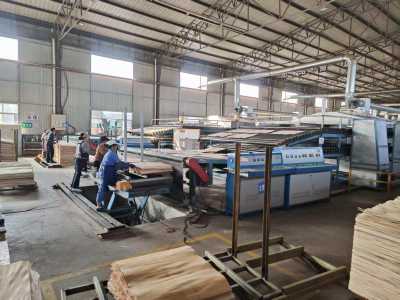
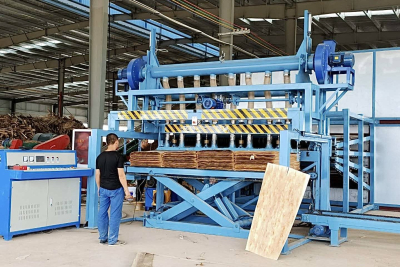
The resulting cut veneer can travel directly toward clipping or drying equipment. Some production lines also wind the veneer onto reels temporarily. This setup helps factories maintain steady production without unnecessary handling.
What Grain Pattern Does It Create?
Broad and Irregular Grain
Rotary cutting exposes growth rings at a relatively flat angle. Therefore, the surface often shows broad, irregular, or wild grain patterns. The appearance depends heavily on the wood species and the log structure.
Some species create simple patterns, while figured wood can produce dramatic effects. Walnut, maple, and other decorative species may show unusual figures. So, rotary cutting does not simply make veneer; it also reveals the personality hiding inside the log.
Why Drying Veneer Matters
Controlling Moisture Content
Freshly peeled veneer contains substantial water. Manufacturers must control its moisture content before gluing or further processing. High moisture can reduce bonding quality and create production problems.
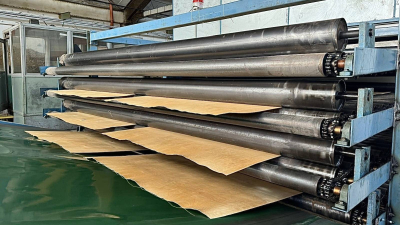
The drying process removes excess water while protecting the veneer from cracking and distortion. Research also shows that uneven moisture content can cause quality issues. For this reason, drying veneer requires careful control rather than simply adding more heat.
Choosing the Right Veneer Dryer
Balancing Quality and Energy Consumption
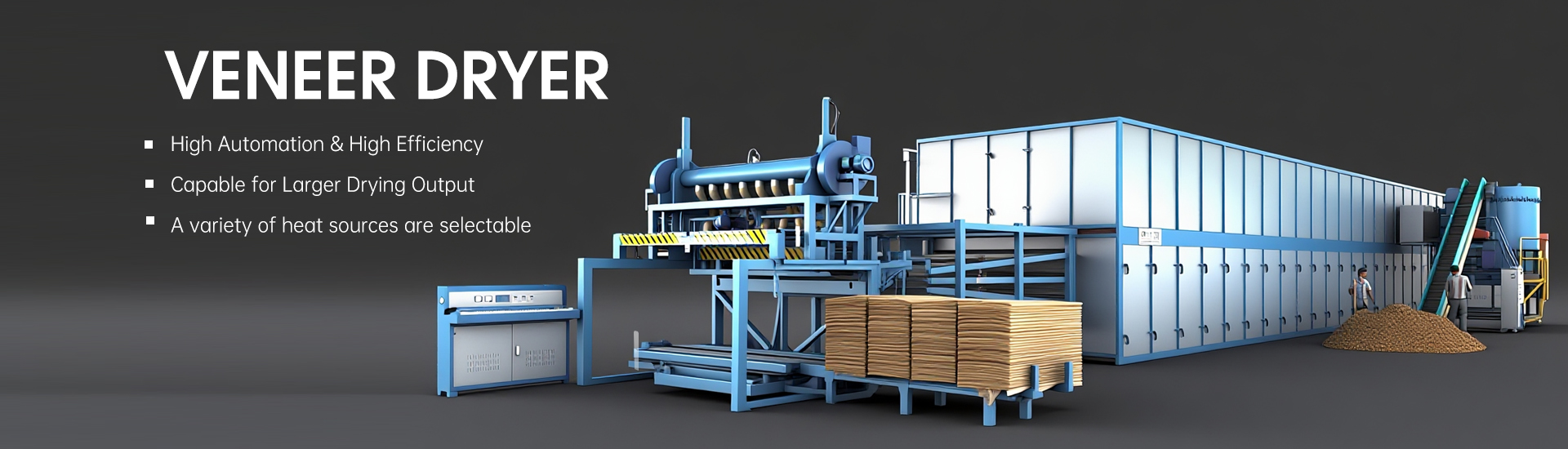
A modern veneer dryer must handle different thicknesses, wood species, and initial moisture levels. Drying temperature, airflow, humidity, and loading conditions all affect drying results. Poor control may cause over-drying, under-drying, buckling, or splitting.
At Shine Machinery, we focus on stable drying and efficient heat use. Our wood veneer dryer designs aim to reduce unnecessary energy consumption while maintaining consistent drying conditions. A properly selected veneer dryer can improve production stability and reduce avoidable operating costs.
Rotary Cut vs. Other Veneer Cuts
When Should You Choose Rotary Cut?
Rotary cut veneer suits applications that need wide sheets and high material recovery. It works especially well for plywood, doors, furniture components, and large panels. Compared with sliced veneer, rotary cutting usually provides a less uniform decorative appearance.
We recommend considering three factors before choosing a cutting method:
Yield: Rotary cutting makes excellent use of the log.
Width: It can produce very wide veneer sheets.
Appearance: Grain patterns can look broad and dramatic.
Production: The continuous process supports efficient industrial output.
Drying: Stable moisture control remains essential after peeling.
In short, rotary cutting combines productivity with a distinctive natural appearance. When the drying stage receives equal attention, manufacturers can produce high quality veneer more consistently.